Writer's Style Guide
A writer's style guide answers many of the pesky questions that plague all but the most astute grammarians among us. Having perfect grammar will not create a powerful piece of writing any more than having sweet breath guarantees you will win a popularity contest. But bad grammar, like bad breath, is a big detractor.
This writer's style guide focuses on the errors I find most often in my work as an editor and in my recreational reading. If you recognize some of these points as areas of difficulty for you, I recommend you use the find feature on your word processor to check your work.
For example, if you are uncertain about your use of the word only, print out the only section of this page (or the whole page if your printer doesn't do sections). Then open your manuscript, under Edit, go to Find and enter the word only. Every time you click the Return button you will find another use of only. Check your use against the explanation from this page.
Even the best writer's style guide has gaps. This one is certainly not complete. If you do not find the answer to your problem on this page, use the form at the end the page to submit your grammar or punctuation question. This is a free service offered in the interest of raising the standard of written English.
You might also consider buying one of the reviewed style guides on this page.
Writer's Style Guide for Grammar
apostrophe: An apostrophe signals one of two things:
- Letters are missing.
Example: Do not becomes don't; the o is missing from not.Possession.
- We show who owns something by using 's.
Example: Jane's book is on the table.
Unless of course you are using...
its/it's: If you look above, you will notice that the word it's should logically always have an apostrophe. But who said English was logical?
If we go with the "letters missing" rule, we would write, It's a shame to have this confusion, meaning,
It is a shame to have this confusion.
If we go with the possession rule, we would write, The bird sang it's song, meaning,
The bird has a song and the bird sang that song.
Whoever writes the rules decided that in the case of it's, we could avoid confusion if we dropped the apostrophe in one case. So...Its is the only possessive ending in s that does NOT have an apostrophe.
Example: The bird sang its song. It's with an apostrophe is only for the contraction for it is.
Example:It's a shame to have this confusion.
only: In technical terms, only can be either an adverb or an adjective. Don't worry if you don't know the difference. What is important to remember, is that only (or any other modifier) should be as close as possible to the word it modifies. Stick with me here. . .
An example may clear things up:
The police are questioning you about a crime. Explaining your alibi, you say, "I only ran to the school." The detective has been watching TV crime shows instead of reading a writers' style guide, so he is confused. He wonders, Does this mean you ran and didn't walk, crawl, or travel by train? Or does this mean you ran to the school and not to the mall, the wharf, or the courthouse?
Remember the rule? The modifier should be closest to the word it modifies. What you have told the detective is that you were running, not crawling or traveling by train. If you wanted to exclude the mall, the scene of the crime, you should say, I ran only to the school. That means you were not at the mall where the crime was committed.
Only is at the top of my current hit list.
Many people, through laziness or ignorance, toss it willy nilly into sentences. English speakers have internalized the rule that a modifier should be closest to the word it modifies. So when only is out of place, the internal grammar police come out and distract the reader momentarily.
that/which: The rule says that introduces restrictive clause. . .
...which introduces a non-restrictive clause.
Yes, and if you knew which was which you wouldn't be having a problem, right? Don't worry. I can give you examples and an easy rule to help you.
Example: Countries that have no coastline experience trade problems.
Example: China, which is the most populous country in the world, is home to the panda.
Now for the helpful rule...
If you take out the clause and your sentence still contains its main message, you have a non-restrictive clause. Compare --
Countries experience trade problems. (removed that have no coastline)
China is home to the panda. (removed which is the most populous country in the world)
When the information in the clause is vital to your meaning, use that.
When the information in the clause is incidental to your meaning, use which and set off the clause with commas.
-ing words: There are at least two ways to confuse your reader with an -ing word.
- An –ing word often introduces a dangling modifier. You can deal with most of your dangling modifiers by considering an –ing opener to be a red warning light.
Here is what this common dangling modifier looks like:
Patting the baby's back, she burped.
Patting the baby's back is a modifier. In this case, grammatically, it modifies she. So what is written is that the woman patting the baby's back burped while she patted the baby's back. Certainly that could happen, but what is the more likely meaning is that while someone patted the baby's back, the female baby burped.
When you see an-ing word at the beginning of a sentence and the red warning light goes off, be sure that the subject of the sentence is what you mean to modify. - When an –ing word is not opening a dangling modifier, its meaning is,...
this is happening while the other action I’m going to mention is happening.
For example, if I say,
Wrinkling his brow, the biker tried to rid his forehead of sweat,. . .
I’m O.K. The wrinkling happened while the sweatlessness happened.
But if I say,
Putting down my tea cup, I turned around,. . .
I’ve just announced spilled tea and maybe a sprained ankle or a protesting cat who has been stepped upon because, grammatically, I’ve put down my tea and turned simultaneously.
What I probably mean is,
I put down my cup of tea and turned around.
OR I put down my cup of tea. I turned around.
OR I put down my cup of tea and then turned around.
Writer's Style Guide for Punctuation
quotation marks: Quotation marks serve two purposes:
- They enclose direct quotations.
- They set apart titles of poems, songs, short stories, magazine articles or one-act plays.
A direct quotation contains the actual words someone said or wrote. An indirect quotation is a report of what someone said or wrote and should not have quotations marks.
Example: Direct quotation -- The writer said, "I wish I understood this better." Use quotation marks.
Example: Indirect quotation -- The writer said that she wished she understood this better. No quotation marks.
Notice that other punctuation marks (commas, periods, question marks, exclamation marks) go inside the quotation marks in North America.
The titles are easy.
Example: Jim's story, "The Use of Quotation Marks," will be published in the first magazine next month.
Do NOT use quotation marks for ANYTHING else.
Your Own Pesky Writing Problem
If you are still uncertain about an issue of grammar or punctuation because this writer's style guide was incomplete or unclear in any way, use the form on this page to receive an answer to your question.
Also, if you have a tip for other writers and want to contribute it to this writer's style guide, submit it on the same page. You will receive credit for your contributions.
This writer's style guide is one free service of Writer's Helper. Return to the home page to discover other editing services.
Ask About Your Pesky Writing Problem
Go ahead and post your pesky writing problem.
If possible, give examples. This will help others to give you the best possible answer.
What Other Visitors Have Said
Click below to see contributions from other visitors to this page...
Old skool apostrophe
I went to school in the 60's and we were taught the apostrophe for possession comes after the s. Janes' book is there. Jane's running would represent …
Beginning sentences with pronouns
I currently tutor ESL students, and a question regarding using pronouns, specifically 'it' to begin sentences has me stumped.
In the sentence, "It …
I want to write but its impossible
I want to write but I can't help but edit the first sentence (words) again and again (because of grammar, change of words or change of idea). Then, my …
Where to begin
The day started as usual. I went in, said good morning to everyone and started My main job description, filing. And my main agitation of filing. Why can't …
Perterbing Pronouns
I'm a wanna-be editor, who has been struggling to find an answer to this question: how do pronouns work in scenes with two people of the same gender? I …
Comma in Title
Example: Jim's story, "The Use of Quotation Marks," will be published in the first magazine next month.
Why was the second comma, after "Marks", put …
Index
Where do indexes go? Front or back at the end of a book?
Problem in using the definite article
Hi,
I'm not a native English speaker; therefore, I always have problem correctly using the definite article "the" in my sentences. Can you please provide …
Do I need permission to use a friend's name in my autobiography?
In my autobiography I am telling about my experience of attending seminary and the friend's I acquired during that experience. What I need to know: "do …
Is it yesterday's, or the previous day's trousers?
Is it grammatically correct to use yesterday in the following context? Thank you.
I walked up the stone staircase wearing yesterday's blue trousers. …
great starts,...so I thought!?!?
I'm brainstorming content pages for my SiteSell site without any sort of control for making progress.
I have counted ten notebooks filled with fleeting …
Quoting thoughts
Would thoughts ever qualify as quotes?
Example 1) I was thinking of going to the mall.
Example 2) I was thinking, "Should I go to the mall?"
Beginning sentences with pronouns
The title is a bit misleading but I couldn't think of what to call this problem. I'm writing an action story and end up saying "He did this. She did that..." …
How can I hammer by grammar?
I've been told I write fairly well. However, no one tells you when you've misplaced a comma or that your sentence needs a little more structure. I'm not …
Weak your story is weak?
Please could you tell me what does a weak story mean.I have written a children's story and have had it returned because it was "to weak?".Help
Should I use acronyms?
Some acronyms seem to be accepted - almost everyone would use '5,000 tons of TNT' rather than '5,000 tons of trinitrotoluene'. How about others though? …
Whether to use rather or whether, that is the question
These definitions still leave me confused.
Whether-(pronoun) used in expressing a choice or alternative.
Rather-(adverb) more willingly, …


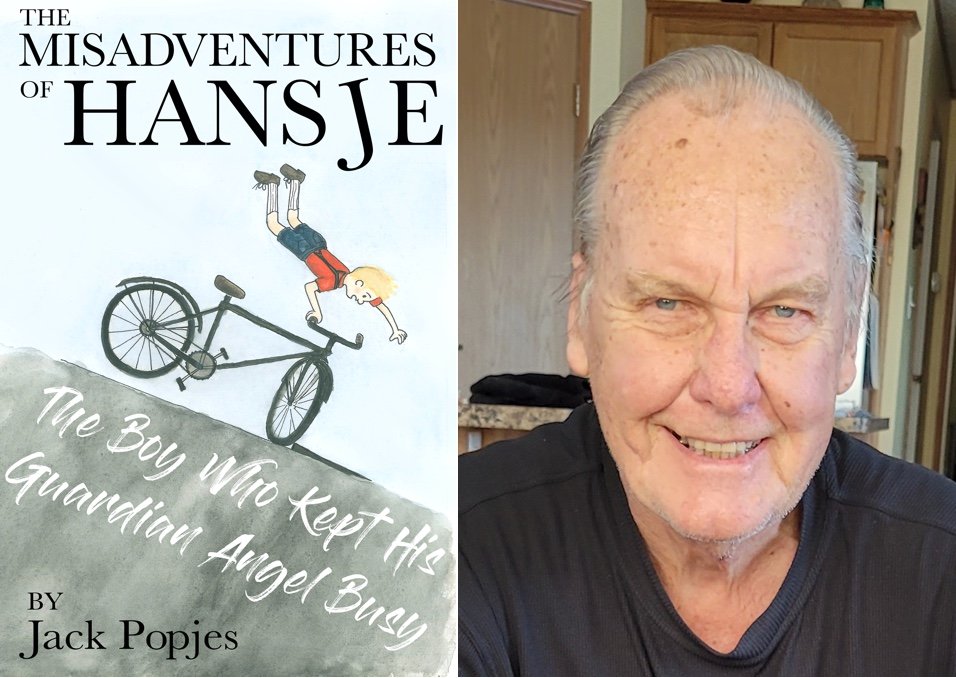
This is Jack Popjes and one of his published books. He and I worked on multiple projects. He's met many goals.
Meet your writing goals in 2023.
Free Newsletter
Sign up below for
Editor's Notes
Inspiration and Writing Tips
and receive tips
to maximize
your use of MS Word.
Click for more information
and archived copies...
Or sign up using the form below
to start your subscription right away.
